
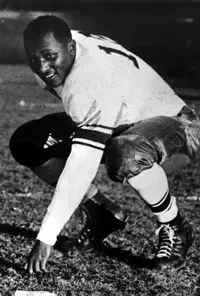
Charles Thomas and Lou Montgomery were contemporaries. Thomas, a halfback for Boston University, directly competed against Montgomery during the late 1930s and early 1940s when the Terriers battled the Eagles. Both men’s lives read like history books, ones filled with stories not often taught in school. Thomas played football, basketball, and baseball at a time when opportunities for African American athletes narrowed due to racial segregation and discrimination. But his integrity, both on and off the field, shattered these restrictions and his courage assured future generations a measure of equality in sports.
Born in Georgia, Thomas eventually joined the Great Migration and moved north. He spent most of his early life in Dayton, Ohio before moving to Boston, Massachusetts to attend college at Boston University. After graduating from college and serving his country with distinction in World War II, Thomas moved to Providence, where he enjoyed a strong presence as a community leader and civil servant working for the city’s recreational department and family court system.
During his athletic career, Thomas competed at the amateur, collegiate, semi-pro, and professional levels. He integrated a few line-ups along the way, but also played on teams comprised solely of non-white players. His multiple experiences provide insight into how black athletes navigated the troubled waters of segregation, found race pride in all-black teams, and showcased their talents to advance the struggle for freedom and equality.
Thomas played on an integrated football team at Boston University. But he was not immune from the indignities of racism. During the 1941 season, he was barred from action against Western Maryland because the Baltimore school followed a strict segregationist policy. Students at B.U. rallied to Thomas’s defense and engaged the local NAACP to raise awareness of the injustice. In response to the protests, the president of B.U. convinced his counterpart at Western Maryland to abandon his school’s restrictive policy. The presidents issued a joint statement endorsing African Americans to compete on the same field in “the best interests of sportsmanship.” Prior to the game, students at nearby Morgan State College hosted a pep-rally for Thomas and fellow teammate Howard (Red) Mitchell in honor of their historic achievement. Author Charles Martin places this story in the broader context of collegiate sporting events that impacted the modern civil rights movement in his book Benching Jim Crow.
Boston University enshrined Thomas in its athletic Hall of Fame in 1969 as an incomparable baseball, basketball, and football player. He was the last of the school’s nine varsity letter winners, an accomplishment that seems unimaginable in today’s world of single sport athletes.
After college, Thomas began a successful professional career as an outfielder with the Newark Eagles in the National Negro League. He signed a contract with Hall of Fame owner Effa Manley and patrolled the outfield in 1941 and 1942. The Eagles roster for those years included Larry Doby, the first black player in major league baseball’s American League, and future Hall of Famers Monte Irvin and Ray Dandridge. The national and local press regularly touted Thomas’s athletic ability and teammate Fran Matthews characterized him as “the guy who could deliver in a clutch.” His professional career ended abruptly when America mobilized for World War II.
Thomas reported for active duty in August 1942. He earned five bronze stars in North Africa, Sicily, France, and Germany. While in the Army, he smashed another racial barrier when he became the first African American to play for the Travelers, the 91st Infantry Division’s championship baseball team. Long before the military was officially desegregated in 1947, its sports teams leveled the playing field for its black athletes. Thomas’s accomplishment served as an early example of the transformative power of sports to successfully challenge state sanctioned segregation.
When the War ended, Thomas returned to Providence and became a standout on the semi-professional Boston Colored Giants playing alongside the popular veteran battery of Will “Cannonball” Jackman and Burlin White. As a member of the Giants, he frequently traveled to Cardines Field in Newport to challenge the Sunset League All-Stars. Newport’s legendary sportswriter George Donnelly once remarked, “if the color line had been broken earlier, Charley would have been a major league star.” In the offseason, Thomas enjoyed an equally successful football career as a member of the Providence Steam Roller team in 1947 and 1948.
Charles Thomas reminds us that sport occupies an important and influential space in American history. Although he rarely received the public recognition he deserved, he never played or lived in the Shadows. Those touched by his words and actions will always remember “Mr. Thomas” as a larger-than-life man who reminded them that the struggle for racial equality can be found in several different arenas, including the baseball diamond, basketball court, and football field. He left a legacy worth preserving.
Robert Cvornyek is professor emeritus of History at Rhode Island College, and teaches and writes on issues of social justice, with a focus on race and sports. His recent publications include Race and Resistance in Boston: A Contested Sports History, and Boston’s Black Athletes.